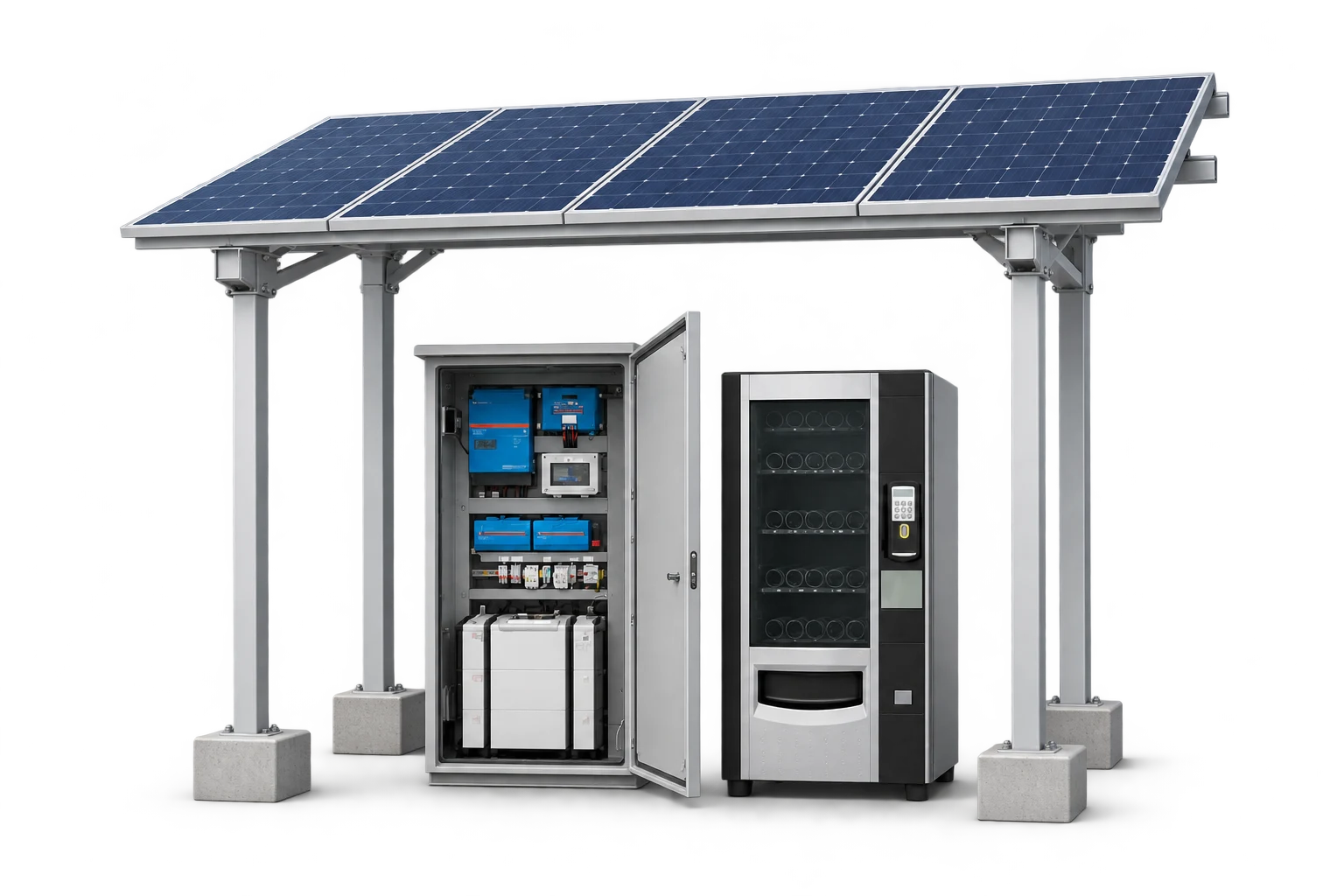
Why DinoTech uses LFP batteries.
Sunlight powers the day. The right battery carries it further.
Discover why lithium iron phosphate is our choice for storing solar energy, supporting refrigeration, and keeping outdoor vending practical.
Explore the differenceSame job.
Different technology.
Choose a topic to see what changes, and what that means for an outdoor vending site.
Compare what you install. See what you can use.
These banks provide approximately the same usable reserve. The difference is how many battery units it takes to get there.
manufacturer-rated usable energy
Each module is already rated for usable energy. No second discharge deduction is applied.
estimated usable energy
12 × 12 V, 200 Ah GEL batteries give 28.8 kWh nominal. This example uses half that capacity.
Similar usable reserve. Fewer battery units.
15 kWh and 14.4 kWh are approximately comparable reserves, not identical capacities or matched laboratory tests. Actual delivered energy depends on temperature, discharge rate, and the inverter.
Sources: BYD / FinDreams LV5.0 documentation · Trojan: lead-acid battery guidance · EURONET 12 V 200 Ah GEL example
A lighter foundation for outdoor vending.
For the illustrated banks, LFP reduces battery weight by approximately 83%. That can simplify structural design and relocation.
battery bank weight
3 modules × 42 kg. Less battery mass to support, handle, and relocate.
battery bank weight
12 batteries × 60 kg. Approximately comparable reserve, with considerably more mass.
Battery weights only. Enclosures, mounting, and cabling are excluded. Illustrations show module counts, not physical scale.
Sources: BYD / FinDreams LV5.0 documentation · EURONET 12 V 200 Ah GEL example
Keep more of the energy the sun gives you.
Follow the same charging input through each battery. Lower losses leave more solar energy available for the machine.
module-rated round-trip efficiency
The output illustration uses 95%. Actual performance depends on operating conditions.
general lead-acid efficiency example
An average from general guidance, not a measured efficiency for this specific GEL bank.
Battery-only illustration at 95% and 80% efficiency. It excludes inverter, controller, and wiring losses and does not establish whole-system efficiency or a grid bill saving.
Sources: BYD / FinDreams LV5.0 documentation · Victron: LFP and lead-acid behaviour
A long life starts with the right conditions.
Explore the factors behind lifetime and servicing. Chemistry matters; installation and use matter too.
Cycling
Victron LFP reference: 2,500 cycles at 80% discharge; 5,000 at 50%, with at least 80% capacity remaining.
Cycling
Victron GEL reference: 500 design cycles at 80% discharge; 750 at 50%. Shallower discharge extends cycle life.
Manufacturer reference ranges, not industry averages or ratings for the illustrated DinoTech and EURONET banks. Calendar life and cycle life are different; temperature, charging, and test criteria affect actual life.
Sources: Victron: Lithium Smart cycle-life ratings · Victron: GEL deep-cycle design life
The first price is
only the first chapter.
Explore how replacements could change battery procurement cost over 10 years. You choose the assumptions.
Choose a replacement scenario
Count full-bank replacements during the 10-year comparison period. Each bank is purchased once at the start.
Starting assumptions
LFP AED 12,000
Lead-acid AED 10,200
Battery procurement cost
Initial bank + 0 replacements
Initial bank + 0 replacements
LFP costs more in this scenario.
An illustration, not a prediction. This is not a lifetime guarantee or a current quotation. Prices are illustrative assumptions, not DinoTech’s procurement costs or equipment sale prices.
Totals = initial bank price × (1 + full-bank replacements). Prices remain constant. Excludes VAT, labour, maintenance, transport, recycling, enclosures, other equipment, inflation, discounting, and residual value. Replacement counts are selected scenarios, not predicted lifetimes.
Better batteries still
need good engineering.
UAE heat, dust, and outdoor exposure shape the installation. Battery chemistry is one part of the solution.
Explore the complete DinoTech systemProtect the enclosure
The LV5.0 module is rated IP20. It needs suitable protection from rain, dust exposure, and other outdoor hazards.
Manage the temperature
Module operating limits: charging 0 to 50°C; discharging -20 to 50°C. These are limits, not ideal operating targets.
Monitor and maintain
Battery management, correct charging, and inspection support reliable operation. Long-term performance depends on real site conditions.
Before you compare.
The details that keep a battery comparison useful and fair.
Why compare usable energy instead of just the label?
Nominal capacity describes installed storage. Usable energy accounts for the operating range being compared. BYD already rates this module at 5 kWh usable under its stated test conditions; that figure should not be reduced a second time. The lead-acid example uses an assumed 50% discharge, not a universal technical limit.
Is LFP always the cheaper option?
No. Lead-acid has the lower initial battery cost in this example. Replacements can change the result in either direction. The scenario assumes constant bank prices and counts whole-bank replacements; it does not predict when they will happen or guarantee savings.
Does a ten-year scenario mean a ten-year battery warranty?
No. Ten years is only the selected comparison period. Actual service life and applicable warranty terms depend on the exact product, installation, temperature, charging, and use. No fixed FD-LV5.0 service life is promised here.
Can these batteries sit outside in UAE heat?
The module needs a suitable protective enclosure and thermal management. IP20 is not an outdoor weatherproof rating. Manufacturer operating limits describe permitted conditions, not an ideal temperature or a guarantee of life in continuous heat.
Does higher battery efficiency mean a lower electricity bill?
For off-grid vending, lower storage losses primarily mean more of the available solar energy can reach the load. This does not automatically translate to grid electricity savings. Inverter, controller, wiring, and refrigeration performance also affect whole-system results.
Are LFP batteries impact-free?
No battery is impact-free. Manufacturing, transport, service life, and end-of-life recovery all matter. Lead-acid has established recycling systems, and LFP also requires appropriate recycling. This comparison does not establish a whole-lifecycle carbon advantage.
Sources, not small print.
Specifications describe a product under stated conditions. Scenarios show what happens under chosen assumptions.
- BYD / FinDreams LV5.0 documentation
Manufacturer-authored manual, hosted by Device.report; technical parameters and module label. Reviewed 7 November 2026.
- Trojan: lead-acid battery guidance
General guidance on discharge, maintenance, and temperature. The 50% discharge example is a design assumption, not a limit applying to every lead-acid battery.
- Victron: LFP and lead-acid behaviour
General efficiency and partial-charge guidance. Its approximately 80% average lead-acid efficiency is an illustrative reference, not a test of the GEL bank shown here. Its LFP ratings are not attributed to DinoTech.
- EURONET 12 V 200 Ah GEL example
Supplier-listed voltage, capacity, and 60 kg net weight. Capacity is rated at a ten-hour discharge rate and 25°C. Used to illustrate a lead-acid bank, not a retrofit recommendation.
- Victron: Lithium Smart cycle-life ratings
Reference product: 2,500 cycles at 80% depth of discharge and 5,000 at 50%, with at least 80% nominal capacity remaining. These are Victron ratings, not a DinoTech / BYD module specification or an industry average.
- Victron: GEL deep-cycle design life
Reference product: GEL Deep Cycle design life of 500 cycles at 80% discharge and 750 at 50%. These are Victron ratings, not a rating for the EURONET bank or an industry average. Test methods and end-of-life criteria may differ between products.
How the main figures are calculated
- 15 kWh
- 3 modules × 5 kWh already-usable DC energy; no additional discharge factor.
Manufacturer-rated DC usable energy, 0.2C charge/discharge at 25°C. Inverter and system conditions affect delivered energy. - 28.8 kWh
- 12 batteries × 12 V × 200 Ah ÷ 1000.
Supplier-listed capacity at a ten-hour discharge rate to 1.80 V/cell, at 25°C. Capacity varies with discharge rate. - 14.4 kWh
- 28.8 kWh nominal × 50% assumed discharge.
Illustrative 50% discharge; approximate reserve comparison, before inverter losses. Discharge rates and temperatures are not identical tests. - 126 kg
- 3 modules × 42 kg.
Module-only weight; excludes enclosures, mounting, and cabling. - 720 kg
- 12 batteries × 60 kg net weight.
Supplier-listed net battery weight, excluding enclosures and cabling. - 82.5 %
- (1 − 126 kg ÷ 720 kg) × 100.
For the illustrated approximately comparable reserves only; excludes enclosures, mounting, and cabling. - 0.95 kWh
- 1 kWh charging input × 95% illustrative efficiency.
Manufacturer-rated round-trip efficiency of at least 95%; use 95% for this battery-only illustration, excluding other system losses. - 0.8 kWh
- 1 kWh charging input × 80% illustrative efficiency.
Approximately 80% average lead-acid round-trip efficiency from general guidance, not a measurement of this GEL bank. - 0.05 kWh
- 1 kWh charging input × (1 − 95% illustrative efficiency).
Manufacturer-rated round-trip efficiency of at least 95%; use 95% for this battery-only illustration, excluding other system losses. - 0.2 kWh
- 1 kWh charging input × (1 − 80% illustrative efficiency).
Approximately 80% average lead-acid round-trip efficiency from general guidance, not a measurement of this GEL bank.
Manufacturer-rated DC usable energy, 0.2C charge/discharge at 25°C. Inverter and system conditions affect delivered energy. The lead-acid usable-energy estimate is not a matched-condition laboratory result.
Let’s put better energy to work.
Considering vending for a park, beach, development, or event? We’ll help you evaluate the complete off-grid setup.