Better storage.
More possibilities.
How a decade of battery innovation changed the possibilities for off-grid vending, and what UAE buyers should assess beyond the price of a pack.
Contents
On this page
The night shift starts with storage.
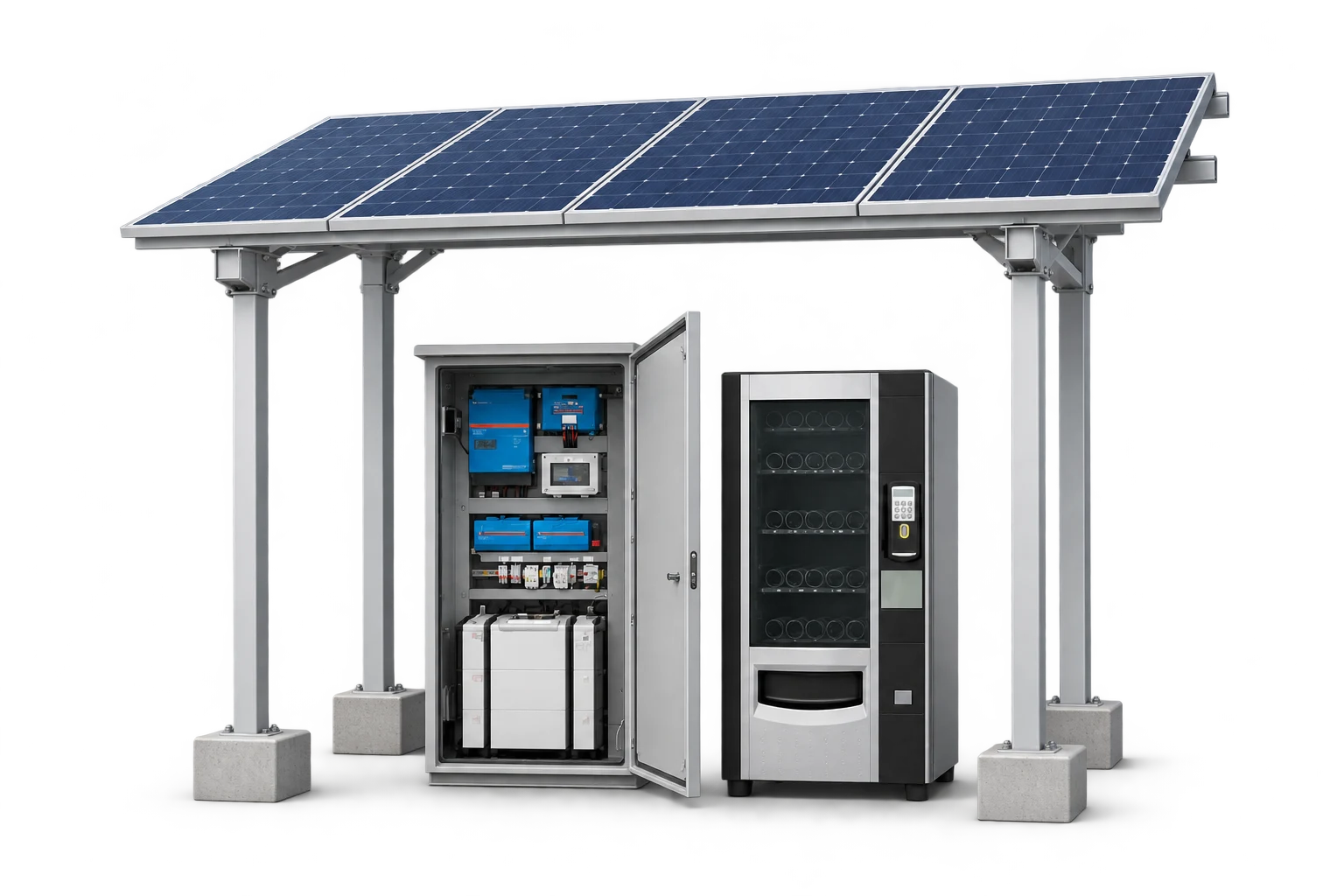
A vending machine does not stop needing power when the sun goes down. Refrigeration, payments and controls still have a job to do. In a solar-powered installation, storage carries daytime energy into the evening and gives the system room to respond when sunlight is weaker. It is a working part of the service, rather than an accessory added at the end.
That is why changes in battery technology matter to outdoor sites. Lower pack costs can make more locations worth assessing, while the choice of chemistry and controls shapes how the system is operated. For a park, beach or development, the useful question is how reliably the complete installation can serve visitors through its operating hours.
lower global pack-price benchmark
2016–2025 · real 2025 US dollars · not installed-system costs
The price history below puts that change in context. It is a market benchmark, not a DinoTech quotation or a promise that a finished installation costs the same percentage less.
A decade of change. A clear basis.
The BloombergNEF series reproduced by the World Bank falls from $365 per kWh in 2016 to $108 in 2025, in inflation-adjusted 2025 dollars. It measures worldwide, volume-weighted battery-pack prices across uses, including electric vehicles. The increase in 2022 also matters: progress has not followed a perfectly smooth line.
Battery packs, over a decade.
Real 2025 USD/kWh · global battery packs
2025 · Historical benchmark$108Real 2025 USD/kWh · global battery packs
Worldwide volume-weighted pack prices across applications, including electric vehicles. Not a UAE retail price or an installed storage quotation. Annual observations end in 2025.
Source: World Bank / ESMAP (2026), Figure 2.3; BloombergNEF price survey
View annual data: Real 2025 USD/kWh · global battery packs
| Year | Benchmark | Status |
|---|---|---|
| 2016 | $365 | Historical benchmark |
| 2017 | $273 | Historical benchmark |
| 2018 | $224 | Historical benchmark |
| 2019 | $194 | Historical benchmark |
| 2020 | $169 | Historical benchmark |
| 2021 | $159 | Historical benchmark |
| 2022 | $170 | Historical benchmark |
| 2023 | $148 | Historical benchmark |
| 2024 | $118 | Historical benchmark |
| 2025 | $108 | Historical benchmark |
Worldwide volume-weighted pack prices across applications, including electric vehicles. Not a UAE retail price or an installed storage quotation. Annual observations end in 2025.
World Bank / ESMAP (2026), Figure 2.3; BloombergNEF price survey
A small solar installation is bought on different terms from a large-volume pack transaction. Its cost includes integration, protection, a suitable enclosure, transport, commissioning and service. The chart helps explain an industry shift; a site assessment establishes the equipment and work required for a particular location.
Choose the battery for the job.
Lithium-ion describes a family of chemistries. Lithium iron phosphate, or LFP, is one of them. The IEA identifies its lower cost and longer lifetime relative to nickel-rich alternatives as reasons it suits stationary storage. A battery that takes more space can still be a sensible choice when weight and volume are less restrictive than in a vehicle.
Chemistry
LFP is a lithium-ion chemistry. Match the exact product, protection and controls to the application; the chemistry name alone is not a performance specification.
Usable energy
Compare the energy available within the intended operating range. Reserve capacity and allowed discharge affect what reaches the load, beyond the number printed on a label.
Efficiency
Keep battery-only DC efficiency separate from whole-system AC efficiency. Inverter, wiring and auxiliary loads sit outside a battery-only measurement.
Life is another question that needs an exact basis. Cycle life describes repeated charging and discharging under stated conditions. Calendar life describes ageing over time. A warranty is a separate commitment. None can be substituted for the others, and a short field monitoring period cannot establish a decade of service.
Our LFP and lead-acid comparison explores usable reserve, weight, efficiency and cycling with the assumptions visible. It is a useful next step when comparing storage options, rather than treating every lithium-ion product as interchangeable.
Design for the temperature inside.
An outdoor installation needs more than a battery with an appropriate capacity. Heat exposure, dust, moisture, service access and electrical protection all belong in the design conversation. Battery temperature inside an enclosure can differ from the weather reading for the site. Shade and enclosure design therefore need to be assessed alongside ventilation or thermal control.
LFP still requires a correctly configured battery management system and appropriate protection. The FD-LV5.0 manufacturer documentation used in our comparison lists IP20 protection. That is not an outdoor weatherproof enclosure rating. Product operating limits are conditions to respect, not a recommended temperature to maintain continuously.
The operating plan should make inspection and intervention practical. Agree who receives alerts, who can reach the equipment, and how charging settings and connections are checked. A location with good visitor demand still needs a workable service route and a suitable place for its equipment.
Start with the load. Then build the reserve.
For a new site, begin with operating hours, refrigeration demand and the daily pattern of energy use. Then assess solar access and the reserve needed through lower-generation periods. Footfall, product mix and restocking access belong in the same conversation: a technically workable installation also needs an operating model that fits the place.
DinoTech’s Dubai pilot case study provides field context, while the public energy dashboard shows available readings with their reporting coverage. Those records answer questions about observed operation. They should be read separately from global price indices and manufacturer lifetime ratings.
Better battery economics widen the possibilities. A clear load assessment, sensible reserve and an achievable service plan turn those possibilities into a proposal that a site owner can review.
Sources, with the boundaries visible.
Methodology and limitations
DinoTech engineering research, November 2026. Evidence reviewed 14 November 2026. Annual histories stop at 2025; no full-year 2026 value is implied. Percentage decreases use (starting value − ending value) ÷ starting value × 100.
Pack prices are volume-weighted global benchmarks in real 2025 dollars across applications and chemistries. They are not LFP-only prices, small-system quotations or delivered installation costs. No battery lifetime, autonomy period or cost saving is inferred from the price curve.
Consult the pilot page and public dashboard for field readings and their coverage. Market research, manufacturer specifications and observed system operation answer different questions and are presented separately.
- World Bank / ESMAP: Remunerating Energy Storage Services: A Global Perspective (2026), Figure 2.3. BloombergNEF pack-price history, real 2025 USD/kWh.
- IEA: Batteries and Secure Energy Transitions (2024), executive summary. Chemistry and stationary-storage context.
- BYD / FinDreams FD-LV5.0 manufacturer documentation, hosted by Device.report. Product conditions; also documented in the existing LFP comparison.
Bring your site into the picture.
Tell us about your location, visitors and operating needs. We’ll start with what the site requires.