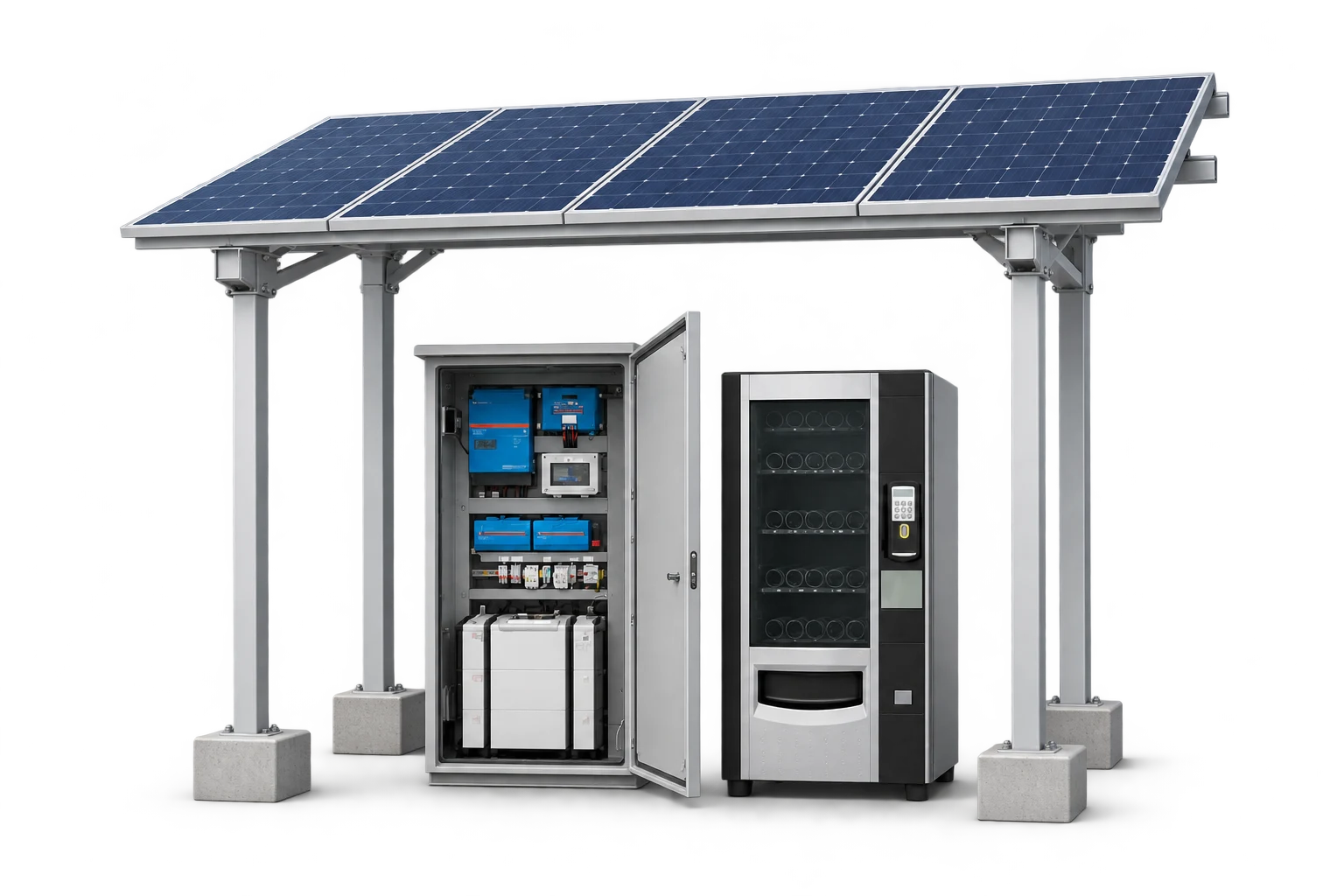
Solar or standard vending?
Start with the site.
Standard vending usually starts with permanent power access. Solar-powered vending starts with the site opportunity: demand, placement, exposure, and whether the location can be served without waiting on fixed infrastructure.
Contents
On this page
How the system works
Solar vending differs from standard vending because it is designed to reduce dependence on permanent grid access. For outdoor UAE sites, that can make placement, pilot speed, and demand testing more practical when a standard vending machine would be limited by powered points.
Standard vending starts with power
A standard outdoor vending project often begins by asking where power is available, then fitting the machine around that answer. That can work, but it can also force poor placement.
Solar vending starts with site demand
Solar-powered vending lets buyers ask where the machine should be useful first, then evaluate whether the solar, battery, access, and maintenance conditions can support that placement.
The decision is about risk
For many outdoor sites, the key question is whether to spend on infrastructure before demand is proven. A pilotable solar vending model can reduce that early decision risk.
Where it fits best
- Buyers comparing off-grid placement against grid-dependent vending
- Outdoor sites where the best customer location is not near easy power
- Pilot projects that need flexible placement before permanent works
- Teams deciding whether infrastructure cost is justified by demand
Start with the location.
Footfall, sunlight, access and approvals help determine whether a pilot is worth exploring.
- Compare the best customer location against the easiest powered location
- Estimate whether fixed power work is justified before demand is proven
- Check sun exposure, access, safety, and restocking for the preferred placement
- Define what a solar vending pilot should prove operationally
- Keep public claims limited to approved energy and deployment evidence
When a site becomes an opportunity
Powered point in the wrong place
A site has power nearby, but the powered location is not where people gather or buy refreshments.
Pilot before permanent works
A buyer wants to validate demand and product mix before investing in cabling or utility coordination.
Temporary or shifting demand
An event, season, or changing site plan makes a fixed vending location less attractive than a relocatable option.
Pilot evidence
Explore measured performance from DinoTech's Dubai pilot.
Days with reported data
Dubai dates with any usable public solar or consumption reading; a complete day is not required.
Solar energy supplied
Summed from approved public hourly solar readings.
Grid import
Off-grid / not publicly reported
- DinoTech is positioned for outdoor sites where permanent power is a deployment constraint.
- Solar vending can support pilot flexibility where standard vending would be tied to powered points.
- The Dubai pilot gives the comparison a real local evidence base.
- The page does not claim unapproved CO2 savings or expose raw diagnostics.
Common questions
What is the main difference between solar vending and standard vending?
Standard vending typically depends on a permanent power connection. Solar vending uses solar generation and battery storage so suitable outdoor sites can be evaluated without starting from fixed grid access.
Is solar vending always better?
No. It is most useful when placement flexibility, pilot speed, or hard-to-power conditions matter. A standard vending machine may still suit indoor or already-powered locations.
What should buyers compare first?
Buyers should compare customer location, power access, infrastructure cost, approval timeline, maintenance access, and whether the site needs a pilot before permanent works.
Can solar vending support temporary sites?
Yes. Solar-powered off-grid vending can be useful for temporary or changing sites when the placement needs to follow demand rather than fixed utilities.
Have a location in mind?
Tell us about the site and what you want to explore. We'll help you work through the next step.
Discuss your site